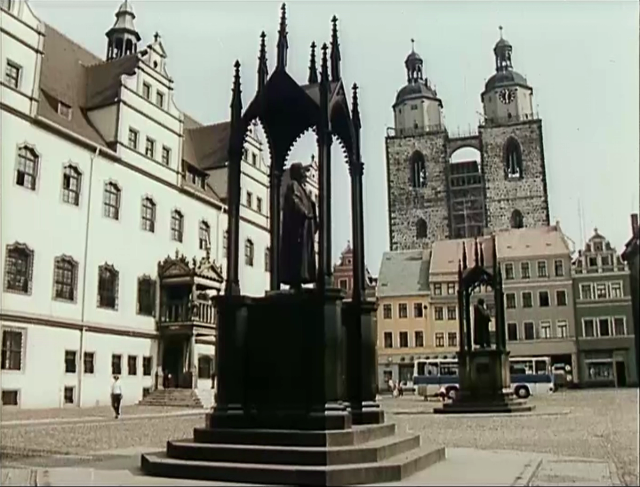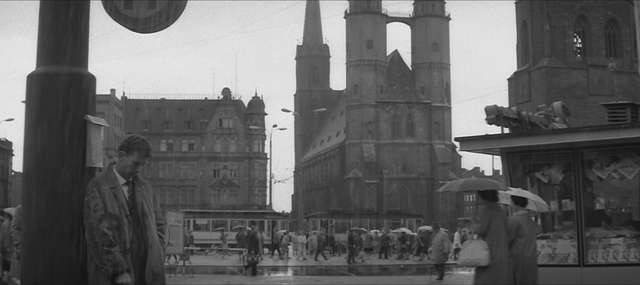
Location 2023
It's hard to believe - Halle may not be located by the sea, but it is still a Hanseatic city and, moreover, closely linked to German history. The Thirty Years' War, free corps fights, or the founding of the SPD in October 1890 – Halle is a historical place.
Not only was the composer Friedrich Georg Händel (1685-1759) born here, but today the cultural oasis on the Saale often serves as the location for numerous film productions. The city has an enchanting river landscape and historical architecture spanning five centuries. The four-towered market church is especially impressive, with 76 bells, the second largest Glockenspiel in the world. The market square with its Red Tower is an eye-catcher for all location scouts.
Although the Beatles never performed in Halle, Halle shone with its own Beatles museum.
Halle is home to one of Europe's largest publicly funded cultural foundations, the Kulturstiftung des Bundes (The German Federal Cultural Foundation). Since its founding in March 2002, it has supported some 4,000 contemporary culture projects.
meet, connect, get in touch, discover
One only sees what one knows. But one also only knows what one has seen.
When history is told through film and touches its viewers, it sparks an engagement with one's own biography and the biography of a country. By understanding each other through history, we can develop a sense of what history does to us. And, moreover, how we can shape it ourselves.
This is precisely what Filmland Saxony-Anhalt embodies, as few others in Europe. It stands as a creative oasis of ideas, as well as a cluster of closely located production facilities, with numerous historical filming locations and people who understand their craft and see the world through different eyes. It’s worth zooming in on Saxony-Anhalt.
An Ideal Location for Historical Productions
For Saxony-Anhalt in particular, it holds true that culture can only flourish and push boundaries in the presence of a vibrant cultural scene.
For over 500 years, Saxony-Anhalt has been a true world heritage site. It is the region with the highest density of UNESCO World Heritage sites in Germany: the Bauhaus in Dessau, the Luther cities of Eisleben and Wittenberg, the Wörlitz Castle Park, the historic old town of Quedlinburg, and the Naumburg Cathedral. For film productions, Saxony-Anhalt resembles a film set in Babelsberg – but it’s real!
World History – Made in Saxony-Anhalt
Saxony-Anhalt boasts a rich and distinctive cultural history. Martin Luther, its native son, not only nailed his 95 Theses to the door of the Castle Church in Wittenberg but also had a decisive influence on the German language.
In Dessau, the Bauhaus revolutionized the visual language of architecture and design – without this inspiration from Saxony-Anhalt, Manhattan would surely look different today.
Likewise, the lawyer and politician Otto von Guericke gained worldwide fame through his experiments on air pressure with the now-famous Magdeburg hemispheres. In short, Saxony-Anhalt is one of the birthplaces of modernity.
Due to its prominent role in the Middle Ages, a film-ready backdrop of castles, palaces, and other architectural wonders still exists today. It is little wonder, then, that Saxony-Anhalt has long served as the perfect film studio.
Among many others, the films "The Physician," "Pope Joan," and George Clooney's "The Monuments Men" were all shot in Saxony-Anhalt. In 2016, Wernigerode became the backdrop for François Ozon's award-winning French-German film "Frantz" – a cinematic masterpiece that portrays history as a grand epic of emotions.
No Future Without Heritage
Yet, what is possible today has a cinematic backstory that spans nearly four decades. As early as 1954, the DEFA Studio (Deutsche Film AG) began filming historical material in Quedlinburg in what is now Saxony-Anhalt.
While the DEFA had primarily produced industrial films to that point, here they dared to adapt Theodor Storm's novel, "Pole Poppenspäler," for the screen. This marked the birth of the DEFA as an architect of exceptional literary adaptations.
One film that nearly every citizen of the former East Germany has seen is "The Adventures of Werner Holt," based on Dieter Noll's novel, and in 1979, the Russian adaptation of "Baron Munchausen" was filmed in Wernigerode Castle.
The Right Rhythm for the Perfect Production
Saxony-Anhalt may not be a hidden gem among filmmakers, but its open secret is the foundation for exceptional films. In Halle and Magdeburg, you'll find outstanding film productions, talented casting professionals, and filmmakers from every imaginable field. This reputation didn't happen by chance.
The driving force behind it all is the Mitteldeutsche Medienförderung, which transforms film and media projects into promising productions.
We also hold a deep commitment to the education and development of filmmakers, as well as fostering exchange through festivals such as the Professional Media Masterclass by Worklights Media Production GmbH, the Werkleitz Festival 2022 by Werkleitz Gesellschaft e.V. in Hettstedt, continuing education programs by the International Academy of Media and Arts e.V., the 5th “SILBERSALZ” Science & Media Festival, and the 15th Film Music Days Saxony-Anhalt, all held in Halle, establishing Saxony-Anhalt as a film and cultural hub par excellence.